High-fidelity structural grounding & extraction
for unstructured documents
An open multi-stage extraction framework designed to ingest unstructured documents and generate typed, validated relational graphs using joint vision-language token grounding and constrained decoding. Fully preserves 2D bounding boxes and pixel-level provenance.
Real-time Analysis
Instant contract parsing and clause detection
Entity Relationships
Map connections between legal entities and obligations
Risk Propagation
Detect risk patterns across connected agreements
Knowledge Discovery
Automated insights from contract portfolios
The Ingestion Problem
The Structural Disconnection
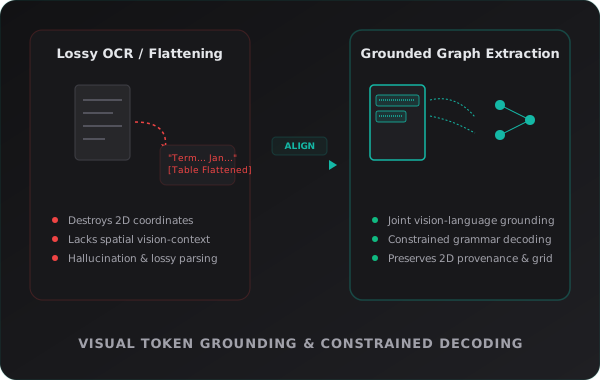
Unstructured documents are complex, spatial, and hierarchical artifacts. Traditional extraction pipelines rely on sequential OCR engines that flatten documents into raw text streams, destroying key semantic structures like cell-to-header relationships in tables, visual layout hierarchies, and margin annotations.
Standard Large Language Models, when prompted with flattened text, lack direct visual grounding and positional references. This makes it impossible to guarantee provenance or verify extraction citations against the source layout, leading to unchecked hallucination risks.
Capabilities
Framework Architecture
Three core pillars of the document-to-schema extraction pipeline
Multi-Modal Token Grounding
Process document page images and text within a unified embedding space. Map cell borders, header contexts, and positional spans directly to target JSON schemas without lossy text flattening.
Relation & Reference Resolution
Resolve defined terms and cross-clause citations deterministically. Anchors terms back to definition sections and parses reference strings to construct a typed document dependency graph.
Composite Confidence Decompositions
Eliminate silent extraction failures. Evaluate extraction logprobs, schema validation checks, and cross-reference redundancies to yield a granular, multi-signal confidence metric.
Process
How It Works
Four sequential execution phases to ingest and extract structured relational graphs
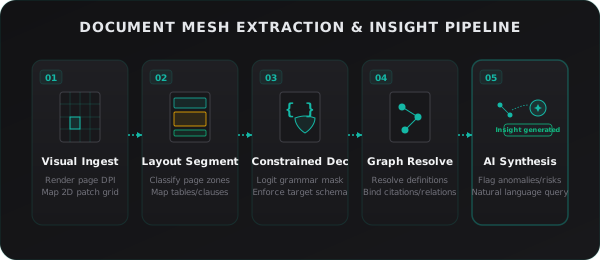
Visual Ingestion
Render incoming files at high DPI, mapping each page to visual token grids via patch projections while retaining 2D positional bounding-boxes.
Layout Segmentation
Run a layout classification pass to segment document structures into narrative clause zones, tables, preambles, and signature blocks.
Constrained Extraction
Generate structured data using context-aware LLMs coupled with logit-level grammar constraints to enforce the target JSON schema.
Dependency Mapping
Perform a deterministic relation pass to bind coreferences, defined terms, and cross-clause citations into a traversable graph.
AI Insight Synthesis
Run plain-text LLM queries over the resolved relational graph to synthesize portfolio-level risks, audit compliance obligations, and detect anomalies.
Applications
Framework Applications
Portfolio Contract Analysis
Analyze and map legal obligations, liability limits, and cross-agreement dependencies across large, unstructured contract repositories.
Financial & Invoice Ingestion
Process complex invoices, billing records, and tax filings. Automate line-item table extraction, payment schedules, and database reconciliation with zero structure loss.
Provenance-Backed Compliance
Verify compliance audits with absolute pixel-to-schema traceability, ensuring every extracted entity is visually anchored back to its original bounding box.