The Architecture
Ingestion, Vectorization & Synthesis
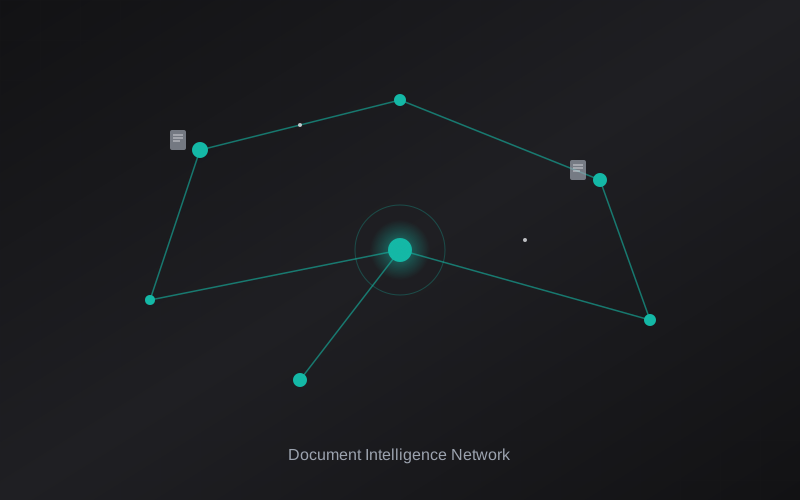
A developer-first, multi-stage pipeline engineered to parse unstructured documents (Word, PDF, Spreadsheets, etc.), index layout-aware spatial embeddings, compile schema-constrained relational graphs, and synthesize semantic insights.
Contact UsCore Modules
Pipeline Capabilities
Multi-Format Visual Ingestion
Bypass lossy text flattening. Parse unstructured documents (Word, PDF, Spreadsheets, etc.) and document scans directly as high-resolution visual token grids. Retain pixel-level 2D coordinates, table hierarchies, and margin annotations natively.
- OCR-free multi-modal visual ingestion
- Coordinate token bounding box grounding
- Table cell-to-header preservation
Layout & Text Embeddings
Project document visual patches and spatial text streams into a unified high-dimensional embedding space. Generate dense vectors containing both visual hierarchy and semantic meaning.
- Vision-Transformer (ViT) patch embedding
- Joint layout-context vector representations
- Cross-page document embedding chunks
Constrained Schema Decoder
Inject logit-level grammar constraints at token generation time. Force Large Language Model outputs to align exactly with predefined, strongly typed JSON schemas with 100% structure compliance.
- Logit-masking compiler constraints
- Schema type and cardinality enforcement
- Calibrated per-field confidence logprobs
Reference Graph Compiler
Run a deterministic post-extraction resolution pass to bind defined terms, section cross-citations, and obligations. Compiles flat JSON extractions into a traversable document network.
- Coreference term binding & mapping
- Cross-section citation dependency routing
- Multi-document package linkage
Vector & Graph Storage
Sync extracted outputs to high-performance databases. Embed layout vectors into vector databases (pgvector, Qdrant) and export relational document networks straight to graph databases (Neo4j).
- pgvector, Qdrant, & Milvus sync integration
- Neo4j & AWS Neptune graph exports
- Hybrid vector-graph semantic search index
AI Insight Synthesis
Apply reasoning agents over the stored vector-graph mesh post extraction. Synthesize risk indicators, audit obligations, and run natural language queries across the entire document portfolio.
- Graph RAG semantic query compilation
- Automated anomaly & risk synthesis
- Cross-document policy audit reporting
Execution Phases
The Ingestion, Vector & Graph Flow
Five sequential stages to parse document layouts, store dense embeddings, and query synthesized insights.
Tokenize
Split document render pixels (Word, PDF, Spreadsheets, etc.) into coordinates and ViT visual patches
Vectorize
Project layout visual context and text into a high-dimensional vector space
Constrain
Generate JSON outputs bound by logit-level schema grammars
Graph Sync
Bind citations and resolved terms into a traversable Neo4j database
AI Synthesis
Apply reasoning agents over the vector-graph storage to compile insights
Integrations
Database & Storage Backends
Synchronize parsed relational graphs and layout vector embeddings directly with your target data infrastructure.
+ Out-of-the-box support for pgvector indexes and custom Neo4j property schemas